


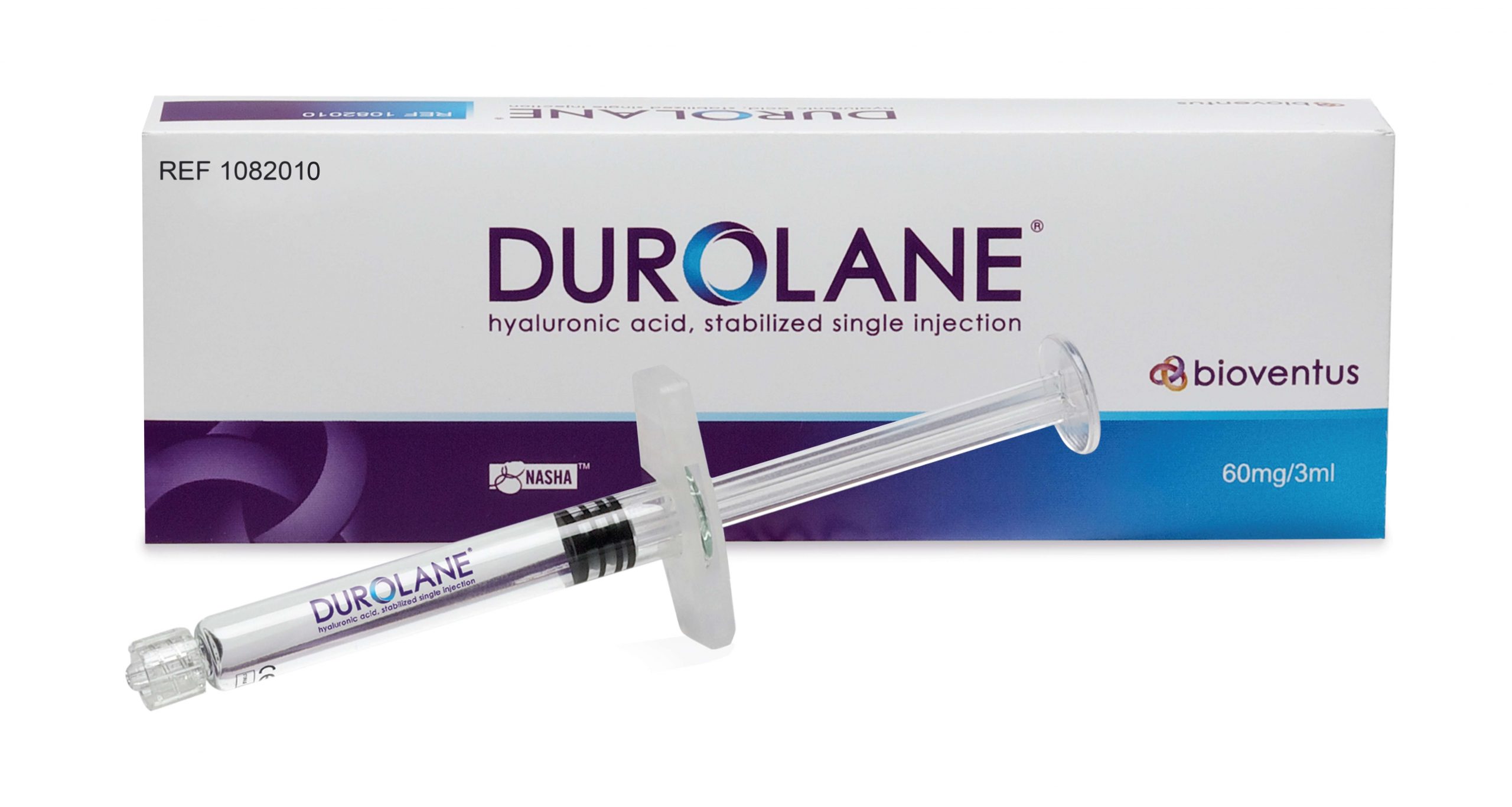
DUROLANE INJECTIONS (Hyaluronic Acid)
DUROLANE® Is a single injection hyaluronic acid (HA) therapy for mild to moderate osteoarthritis designed to provide long-lasting pain relief1
- 20 years of clinical use2, investigated in 20+ clinical studies3 and 2 million+ patients treated4
- Designed to stay in the joint, with a longer residency time, than other HA injections5-8
- May provide up to 12 months of pain relief 1, 9-11
- Reduction in opioid and analgesic use9,12,13
- Approved for multi-joint indications1
- Safe for repeat use1,11,14
- High patient satisfaction11
- Predictable and sustainable results 11,14
What is DUROLANE?
DUROLANE is a unique, single-injection, high molecular weight HA therapy that provides long-lasting pain relief from knee OA and acts as a supplemental lubricant and shock-absorber. The HA in DUROLANE is made with the same material as the natural HA within the human body.10,15
How Does DUROLANE Work?
Hyaluronic acid is a molecule found naturally throughout the human body. It is an important component of joint fluid, called synovial fluid, which provides lubrication and cushioning in normal, healthy joints.15 When you have osteoarthritis of the knee, the hyaluronic acid breaks down and becomes diluted, reducing its natural elastic properties, which can further degrade cartilage tissue and cause increased joint pain.16
Hyaluronic acid in osteoarthritic joints has lost its natural viscoelastic properties, which are needed to protect joint tissues. This loss of viscoelasticity means that the synovial fluid no longer retains the ability to absorb shock and protect surrounding cartilage tissue.
The hyaluronic acid in DUROLANE has the same composition as the natural hyaluronic acid your body produces, but it’s in a highly concentrated formulation that’s been uniquely stabilised to help resist the degradation caused by osteoarthritis.15 DUROLANE is administered as a single-injection directly into the knee.
What Makes DUROLANE Different?
As a patient, you may be presented with different options to treat OA without knowing how each option can help you. The following information can give you a clear understanding of DUROLANE’s design and benefits:
Higher Molecular Weight
With a molecular weight higher than that of the body’s natural HA, DUROLANE can provide longer-lasting pain relief than lower molecular weight HAs, NSAIDs, or corticosteroid injections.9,14,17
Patented NASHA Technology
DUROLANE has a cross-linked and stabilized molecular structure. Its patented chemical design, called NASHA (non-animal stabilized hyaluronic acid), makes DUROLANE highly viscous, shock absorbent, and resistant to degradation.15 These qualities mean that DUROLANE provides extra cushioning and improved range of motion. Because it is resistant to degradation, DUROLANE also may provide longer-lasting pain relief than other OA treatments.15,18
Reduces Pain Sensation
DUROLANE can act as a shield around the pain signals sent from the joint. This may help reduce or eliminate your use of NSAIDs or other pain medications which also means reducing or eliminating the risk of developing side effects of these treatments.17,18
Bio-fermented
DUROLANE is a bio-fermented synthetic product, eliminating avian allergens and reducing the risk of adverse events.15,18,19
Long-lasting Pain Relief
DUROLANE is known for its ability to provide OA patients with long-lasting pain relief.9,14

References
- DUROLANE [package insert]. Durham, NC: Bioventus LLC; 2019.
- Q-Med Scandinavia, Inc. Q-Med’s product for the treatment of osteoarthritis in the knee approved in Europe. Posted May 8, 2001.
- Bioventus LLC. Claim for amount of studies investigating DUROLANE. Data on file, RPT-001367.
- Bioventus LLC. Supporting quantity of global patients treated with a single DUROLANE injection. Data on file, RPT-001056.
- Sakamoto T., Mizuno S., Tominaga A., Tokuyasu K. (1987). Biological fate of sodium hyaluronate (SPH). (4). Studies on absorption, distribution, metabolism and excretion of ¹⁴C-SPH in rats after intravenous, subcutaneous and intramuscular administration. Journal of Applied Pharmacology, Vol. 33, Issue 6, pp. 849–857.
- Larsen, N.E., Dursema, H.D., Pollak, C.T., & Skrabut, E.M. (2011). Clearance kinetics of a hylan-based viscosupplement after intra-articular and intravenous administration in animal models. Journal of Biomedical Materials Research Part B: Applied Biomaterials, 100B (2), 457–462.
- Lindqvist U, Tolmachev V, Kairemo K, Aström G, Jonsson E, Lundqvist H. Elimination of stabilised hyaluronan from the knee joint in healthy men. Clin Pharmacokinet. 2002;41(8):603-13.
- Edsman K, Melin H, Näsström J. A study of the ability of Durolane to withstand degradation by free radicals while maintaining its viscoelastic properties. Poster presented at: 55th Annual Meeting of the Orthopaedic Research Society; February 22-25, 2009; Las Vegas, NV. Poster 1149.
- McGrath AF, McGrath AM, Jessop ZM, Gandham S, Datta G, Dawson-Bowling S, Cannon SR. A Comparison of Intra-Articular Hyaluronic Acid Competitors in the Treatment of Mild to Moderate Knee Osteoarthritis. Journal of Arthritis, Volume 2, Issue 1, 2013.
- Krocker, D., Matziolis, G., Tuischer, J., et al. (2006). Reduction of arthrosis associated knee pain through a single intra-articular injection of synthetic hyaluronic acid. Zeitschrift für Rheumatologie, 65(4), 327–331.
- Carney, G., Harrison, A., & Fitzpatrick, J. (2021). Long-term outcome measures of repeated non-animal stabilized hyaluronic acid (Durolane) injections in osteoarthritis: A 6-year cohort study with 623 consecutive patients. Open Access Rheumatology, 13, 285–292.
- McIntyre, L.F., Beach, W., Bhattacharyya, S., et al. (2017). Impact of Hyaluronic Acid Injections on Pain Management Medications Utilization. American Journal of Pharmacy Benefits, 9(6), 195–199.
- Mackowiak, J., Jones, J. T., & Dasa, V. (2020). A comparison of 4-year total medical care costs, adverse outcomes, and opioid/prescription analgesic use for 3 knee osteoarthritis pain treatments: Intra-articular hyaluronic acid, intra-articular corticosteroids, and knee arthroplasty. Seminars in Arthritis and Rheumatism, 50(6), 1525–1534.
- Leighton R, Åkermark C, Therrien R, et al. NASHA hyaluronic acid vs methylprednisolone for knee osteoarthritis: a prospective, multi-center, randomised, non-inferiority trial. Osteoarthritis Cartilage. 2014;22(1):17-25.
- Ågerup B, Berg P, Åkermark C. Non-animal stabilized hyaluronic acid: a new formulation for the treatment of osteoarthritis. BioDrugs. 2005;19(1):23-30.
- Balazs EA, Denlinger JL. Viscosupplementation: a new concept in the treatment of osteoarthritis. J Rheumatol Suppl. 1993; 39:3-9.
- Maheu E, Bannuru RR, Herrero-Beaumont G, Allali F, Bard H,Migliore A. Why we should definitely include intra-articular hyaluronic acid as a therapeutic option in the management of knee osteoarthritis: results of an extensive critical literature review. Semin Arthritis Rheum. 2019;48(4):563-72.
- Altman R, Lim S, Steen RG, Dasa V. Hyaluronic acid injections are associated with delay of total knee replacement surgery in patients with knee osteoarthritis: evidence from a large U.S. health claims database. PLoS One. 2015;10(12):e0145776.
- Zhang H, Zhang K, Zhang X, et al. Comparison of two hyaluronic acid formulations for safety and efficacy (CHASE) study in knee osteoarthritis: a multicenter, randomised, double-blind, 26-week non-inferiority trial comparing Durolane to Artz. Arthritis Res Ther. 2015;17(1):51.